Learning Freedom Within Boundaries: Fish Is Fish
“And you will know the truth, and the truth will set you free.” (John 8:32)
1. The First Step of Self-Awareness: Identity as a Child of God
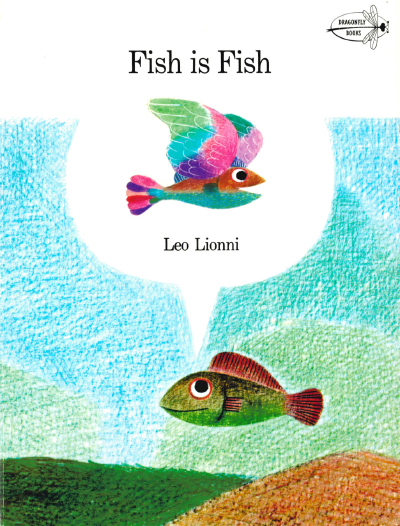
If we were to identify the central theme of Leo Lionni’s Fish Is Fish, it revolves around identity and self-awareness—a core subject in modern picture books. What, then, is the foundational first step of genuine self-awareness? It begins with a clear identity as a child of God. Because we are created by an almighty and sovereign Creator, we are called to acknowledge His authority, His rule, and His perfection, living not by our own shifting standards, but by His.
Just as a fish cannot survive outside of water, humanity cannot truly live apart from the Word of God. The world constantly whispers that true freedom means living entirely according to your own desires and impulses. Yet Scripture reminds us that unbridled self-will is the very root of sin. A child of God discovers genuine joy and liberating peace only when living by God’s Word. In the same way, the little fish finds complete freedom not upon dry land, but within the sustaining waters of its pond.
How do we learn to live by God’s standards? The first lesson our children must grasp is obedience. In turn, obedience is the primary discipline parents are entrusted to teach. When a young child insists that their own desires supersede their parents' guidance, loving correction must gently steer their stubborn will. Today’s culture often mislabels instruction as oppression and discipline as trauma, leading many to believe that passive parenting is a virtue. The consequence, however, is a generation immersed in fragile self-absorption.
2. Train Up a Child in the Way He Should Go
Scripture speaks clearly on parental guidance: “Train up a child in the way he should go; even when he is old he will not depart from it” (Proverbs 22:6). It also instructs parents with urgency: “Do not withhold discipline from a child; if you punish them with the rod, they will not die” (Proverbs 23:13). From an early age, training in obedience equips children with self-control, enabling them to surrender self-centered instincts and walk the path of life.
“Whoever heeds instruction is on the path to life” (Proverbs 10:17), and “the ear that listens to life-giving reproof will dwell among the wise” (Proverbs 15:31), while “he dies for lack of discipline” (Proverbs 5:23). When we lean solely on our own understanding, we forfeit life—much like a fish stranded on the grass. Loving obedience is not merely an old-fashioned virtue; it is a spiritual fruit that preserves life. Regrettably, the little fish in the story had no parent to guide it away from the perilous shore. Embracing the parental calling to instruct and nurture our children is sacred and eternal work.
When delivered rightly, loving discipline dispels foolishness, restores joy, and cultivates character. Conversely, harsh and erratic punishment exasperates a child. God commands: “Fathers, do not provoke your children to anger, but bring them up in the discipline and instruction of the Lord” (Ephesians 6:4). How should parents practice this godly instruction?
-
Seek God’s wisdom in prayer before correcting.
-
Communicate with deliberate, controlled words wrapped in affection rather than venting raw frustration.
-
Apply established boundaries consistently rather than wavering according to personal mood.
Disciplining with diligence and love brings safety, order, and deep-seated peace to a child’s heart (Proverbs 13:24). Even when our parenting feels imperfect, God grants progressive wisdom to every parent who kneels before Him in humility.
3. Abiding Within Boundaries Is True Freedom and Created Order _ Prof. Eunja Hyun’s “The Freedom of Living Within Boundaries”
The adversary constantly deceives us into believing that dismantling all boundaries constitutes liberation. Yet the boundaries between good and evil, truth and falsehood, are essential. Abiding within these God-given boundaries means far more than mere survival; it is the essence of true freedom. Back inside the pond, the fish can swim freely without fear.
Freedom is often more precious than mere physical existence, for life without liberty is reduced to spiritual bondage. Human history is filled with those who sacrificed their lives for genuine liberty. Because picture books convey narratives with brevity and clarity, their deeper themes shine with exceptional brilliance.
This simple allegory captures the essence of what it means to be human far more concisely than many academic volumes. It brings to mind the enduring words of Virginia Lee Burton during her 1943 Caldecott acceptance speech for The Little House: “The most fundamental things are always the most important, and good art is definitely fundamental.” Remaining within the boundary means flourishing within God’s created order.
4. True Liberty Requires the Law of God_Dr. Pyeongse Cho’s 《Viewing the World Through the Bible》
Consider the biblical account of the Exodus. God delivered the Israelites from Egyptian bondage through miraculous wonders. Yet shortly after gaining freedom, complaints erupted: “We were better off serving the Egyptians; at least we had meat and vegetables.” What does this reveal? Even after God grants profound freedom, fallen human nature tends to gravitate back toward familiar bondage.
In the classic film The Ten Commandments, Moses remarks, “There is no freedom without the law.” Without righteous law, moral authority, and divine order, freedom collapses into chaos. When people live in lawlessness, they inevitably seek order elsewhere—even if it means surrendering to tyranny. Through the sweeping narrative of the Exodus, God demonstrates that humanity requires His moral law to experience genuine, lasting liberty.
5. Freedom of Expression and Thought Demand Moral Boundaries_Michael Knowles’s 《Speechless: Controlling Words, Controlling Minds》
Just as the fish’s reckless leap demonstrated that untethered autonomy leads to ruin rather than flight, society faces the same peril when it detaches freedom from virtue.
In the medieval European university, students studied grammar, rhetoric, logic, arithmetic, geometry, music, and astronomy not merely as technical skills for employment. This classical liberal education was designed to cultivate virtuous people capable of self-governance. We are born prone to selfish desires. If we chase desire unchecked, we succumb to license; but when our passions are refined by virtue and truth, we attain true liberty.
A dangerous cultural trend is conflating license with liberty. License is the impulse to do whatever one pleases, while true liberty is the moral right to do what is good, noble, and right. Unchecked license ultimately destroys liberty. As America's early statesmen warned:
-
George Washington: “Virtue or morality is a necessary spring of popular government.”
-
Benjamin Franklin: “Only a virtuous people are capable of freedom.”
-
Thomas Jefferson: “Without virtue, happiness cannot exist.”
6. Biblical Truth as Total Truth Across All Reality_Nancy Pearcey’s 《Total Truth》
Many Christians compartmentalize their faith, isolating it to church life while uncritically adopting whatever secular ideologies dominate their professional and cultural spheres. Christian educators often embrace secular pedagogy without discernment; Christian entrepreneurs adopt secular business practices without reflection; and families passively absorb the entertainment of a post-Christian culture.
Thinking Christianly means understanding that the Bible provides truth about all of reality—the foundational lens required to interpret every sphere of life. Today, society insists faith remain strictly private. When faith is banished from the public square, our lives become fragmented. God’s Word is not merely a personal message of private salvation; it is total truth for all creation.
The little fish in the story could not stop fixating on birds, cows, and people, filtering them through its own aquatic delusions. What do we meditate upon daily? We must align our thoughts with God’s design. This requires intentional study of His Word and earnest prayer. As parents, we must build a sturdy fence of truth around our homes, guiding our children toward genuine life and freedom.
Parent-Child Guided Discussion:
-
Which scene stood out to you the most, and why?
-
When the fish imagined birds, cows, and people with fish fins and scales, what did that reveal about its perspective?
-
What did you think when the fish decided it simply had to jump out and see the world for itself?
-
Is there something you desperately want to do right now, just like that little fish?
-
Is that desire truly beneficial for you? Why or why not?
-
Why did the fish fail to realize it could not breathe on land?
-
How would the story have changed if the fish had understood its own nature beforehand?
-
What would have been the wisest choice for the fish to make?
-
If you were the fish, what would you have done?
-
How should we respond when our parents give us loving instruction or place boundaries around us?
-
What is the fundamental purpose for which God placed each of us in this world?
-
A fish is a fish, and a frog is a frog—what makes human beings uniquely special in God’s creation?
 |
Haeyoung Lim | Founder & Director of PictureBook Museum
|