Walking the Pilgrimage of Courage with Heavenly Hope: 『Brave Irene』
Having finished the path I would run and kept my faith… (2 Timothy 4:7)
"As an Amazon Associate I earn from qualifying purchases."
William Steig (1907–2003), a giant of twentieth-century children's literature, began creating picture books relatively late at age sixty-one. Despite this late start, his sharp wit and deep insight into the emotional lives of children captivated generations of readers worldwide. Published when he was seventy-nine, Brave Irene (1986)—selected as a New York Times Best Illustrated Children's Book of the Year—represents the distillation of a seasoned master’s craft and an unwavering celebration of the human spirit.
Through the journey of a young girl braving a ferocious blizzard to honor a promise, Brave Irene offers a moving portrait of the perseverance, moral resolve, and heavenly hope that sustain a believer walking through life’s wilderness. Grounded in familial affection and mutual trust, Irene displays remarkable wisdom and fortitude.
Plot Overview
Mrs. Bobbin, an industrious dressmaker living in humble circumstances, finishes an exquisite ball gown for the duchess but suddenly falls ill with a fever. Seeing her mother incapacitated, young Irene volunteers to deliver the large dress box across the mountain in the middle of a gathering blizzard. As Irene struggles against the bitter cold, the wind rips open the box and carries the precious gown away into the tempest. Devastated but determined to take responsibility, Irene refuses to turn back; she presses forward carrying the empty box to confess what happened to the duchess in person. Twisting her ankle and plunging into deep snowdrifts, she reaches the estate at her lowest point of exhaustion, only to discover a miraculous sight: the dress has caught on a tree branch just outside the mansion gates, preserved and intact. Welcomed with open arms, Irene becomes the guest of honor at the ball. The next morning, she returns home safely in a grand sleigh accompanied by the duchess’s physician and thoughtful gifts for her recovering mother.
1. Cultivating Attentive Listening and Focus
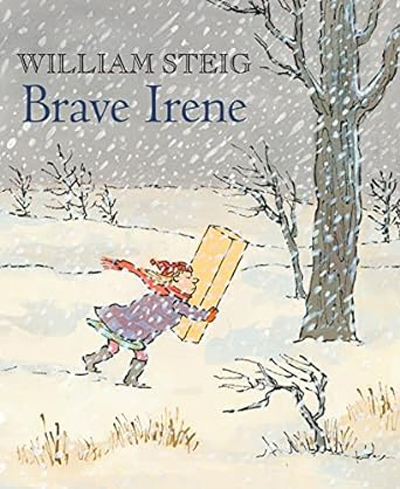
The cover illustration depicts Irene clutching a large, unwieldy box as she battles swirling snow across a deserted, snow-covered ridge. Her expression reveals determination tinged with grit. Before opening the book, taking time to explore the cover with a child invites anticipation. Watching their imagined storylines meet the author's narrative stimulates intellectual curiosity and visual literacy. Because Brave Irene features an expansive text, reading it aloud takes roughly fifteen minutes. Sustaining focus throughout this longer story provides young children with a valuable exercise in patient listening and narrative immersion. Following a developed plotline within a calm, attentive environment lays a solid foundation for reading comprehension, empathy, and critical thinking.
2. A Proactive Heart Rooted in Love
Watching her mother collapse after days of tireless sewing, Irene volunteers without hesitation to make the delivery. She gently eases her mother’s worry with cheerful affection: “I love snow!” Before setting out, Irene’s care for her mother is remarkably tender. She tucks her in with two quilts, adds a blanket at her feet, brews hot tea with lemon and honey, and feeds logs into the stove so the fire will not die. She then wraps the dress box with meticulous care.
“Whatever you do, work at it with all your heart, as working for the Lord, not for human masters.” (Colossians 3:23)
Irene prepares herself with equal diligence: pulling on fleece-lined boots, wrapping her scarf tightly, and donning a heavy coat and mittens. Her actions demonstrate a mature balance between sacrificial love for others and sensible self-preservation. A child who steps up as a co-laborer in times of family hardship reflects the quiet beauty of a home anchored in honor and mutual care (Psalm 127:3).
3. Trials and Resolve in the Path of Duty
As Irene steps outside, the wind howls: “Go home, Irene! Go ho-o-ome!” This chilling voice mirrors the subtle temptations encountered in any difficult journey, urging us to abandon our post: “Give up. You’ve done enough. Nobody expects you to finish.” Faced with this intimidation, Irene digs in her heels: “No! I will not turn back, you wicked wind!”
“Resist the devil, and he will flee from you.” (James 4:7)
Then disaster strikes. The gale rips the lid off the box, sweeps the dress into the air, and carries it away. Seeing weeks of her mother’s labor vanish into the storm would paralyze anyone with grief. Yet Irene makes a courageous choice: instead of retreating to hide her failure, she resolves to carry the empty box to the palace and tell the duchess the truth. Righteousness is not marked by an absence of trial, but by the resolve to rise each time one falls (Proverbs 24:16). When she twists her ankle, loses her footing, and finds herself lost in the gathering dark, Irene refuses to indulge in despair or blame. Clutching the empty box, she limps forward through the whiteout.
“Be strong and courageous. Do not be afraid; do not be discouraged, for the Lord your God will be with you wherever you go.” (Joshua 1:9)
4. Providence and Grace at the Edge of Despair
Shivering and exhausted, Irene falls into a snowdrift. The cold penetrates her bones, and a wave of defeat washes over her: Why not just stay here and freeze? What pulls her back from surrender is love for her mother. Gathering her remaining strength, Irene pulls herself from the snow. In a stroke of practical ingenuity, she sets the empty box beneath her like a sled, coasting down the steep hill toward the valley. Arriving near the gates, a miracle awaits. Caught on the branches of a tree near the entrance is the missing dress, waiting to be retrieved. What secular perspectives attribute to sheer luck, a faith-informed reading recognizes as quiet providence walking alongside faithful stewardship. With trembling hands, Irene folds the gown back into the box and knocks on the palace door.
5. Hospitality and Rest Beyond the Tempest
Upon hearing Irene’s knock, the palace doors swing wide (Matthew 7:7). Servants cry out in celebration, and the duchess is overcome with joy. Taken out of the freezing storm, Irene is seated beside a roaring hearth, dried, offered warm food, and invited to celebrate as an honored guest. The contrast between the dark blizzard outside and the warm, candlelit banquet hall evokes the ultimate reward awaiting the faithful pilgrim. Having endured the narrow, testing path, the weary traveler is received with honor into the banquet of the King.
“The kingdom of heaven has been forcefully advancing, and forceful people lay hold of it.” (Matthew 11:12)
6. The Pilgrim's Way: Echoes of The Pilgrim's Progress
Irene’s journey carries distinct echoes of John Bunyan’s classic The Pilgrim's Progress. Christian, walking away from the City of Destruction with a heavy burden strapped to his back, resembles Irene pressing through the mountain gale clutching her bulky box.
Christian’s despair as he sinks into the deep waters of the River of Death right before the Celestial City parallels Irene’s desperate moment buried in the snowdrift with the palace lights in view. Just as Christian grasps the promises of Scripture to cross the river and step into the Celestial City, Irene perseveres through her darkest hour to enter the warm fellowship of the palace.
“When you pass through the waters, I will be with you; and when you pass through the rivers, they will not sweep over you.” (Isaiah 43:2)
Life often feels like an uphill trek against fierce winds. By carrying our daily responsibilities with integrity and keeping our eyes fixed on what lies ahead, we discover that the hope of the heavenly reward (2 Timothy 4:7–8) anchors the soul through every storm.
“The Lord will rescue me from every evil attack and will bring me safely to his heavenly kingdom.” (2 Timothy 4:18)
Parent-Child Guided Discussion
-
How would you describe the relationship between Irene and her mother under ordinary circumstances?
-
If you were in Irene’s position—knowing an urgent delivery was needed while your mother was sick in bed—how would you have responded?
-
What stood out to you about the specific ways Irene cared for her sick mother (making tea, adding blankets, stoking the fire)?
-
When someone in our family is unwell, what are practical ways you can help?
-
How old do you imagine Irene to be?
-
About how far do you think it was from Irene’s house to the duchess's estate?
-
What feelings do you think Irene experienced as the wind and snow grew more violent?
-
How would you have felt the moment the carefully crafted dress was torn away by the wind?
-
Have you ever experienced a time when something precious was lost or plans fell apart despite your best efforts?
-
Why do you think Irene chose to keep going to the palace even after the dress was lost, rather than turning back home?
-
Have you ever felt lost or helpless in an unfamiliar setting?
-
Like Irene pulling herself out of the snowbank, have you ever had to push through a tough situation on your own?
-
Have you ever faced a sudden problem and come up with a creative solution to solve it?
-
Do you think finding the dress caught in the branches was pure chance, or something more?
-
What makes it difficult to tell the truth when an accident happens? Have you ever had to be honest about a mistake?
-
Can you recall a time in your own life when an unexpected blessing arrived right in the middle of a difficult day?
-
How did you feel watching Irene dance at the grand ball after everything she had endured?
-
What has been the most challenging experience you have faced so far?
-
If you were to choose ten words to describe Irene’s character, what would they be?
-
Which three qualities of Irene would you most like to develop in your own life?
-
Which illustration or scene in the book stayed in your memory the most, and why?
-
What thought remained with you long after closing the book?
-
What core message do you think William Steig wanted young readers to take away from this story?
 |
Haeyoung Lim | Founder & Director of PictureBook Museum
|