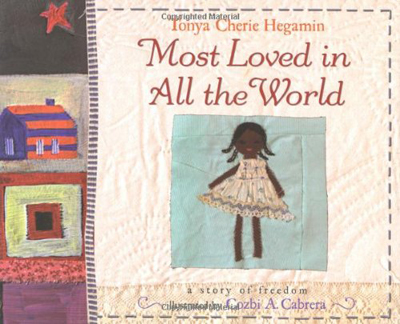
Most Loved in All the World
- 그림작가 코즈비 A 카브레라 (Cozbi A. Cabrera)
- 글작가 Tonya Cherie Hegamin
- 출판사 HMH Books
- 페이지40 쪽
- 발행일2008-10-20
- 수상내역
책 내용
An authentic and powerful account of slavery and how a handmade quilt helps a little girl leave home for freedom.
With a poet's keen ear, Tonya Hegamin tells the account of a little girl whose mother is a secret agent on the Underground Railroad. Before sending her daughter north to freedom, the mother sews a quilt for her daughter, not only to guide her with its symbols of moss and the north star, but also to remind her always that the smiling girl in the center of the quilt is "most loved in all the world." Strikingly illustrated in unique textile collaging and expressive acrylic paintings.
출판사 보도자료
From School Library Journal
Grade 3–6—A slave mother creates a quilt to guide and comfort her young daughter, whom she is sending to freedom along the Underground Railroad. In a straightforward, heartfelt story written in dialect, Hegamin shows that a woman can love her child dearly yet still give her up, in the youngster's best interest. An author's note explains that debates over the authenticity of quilts used as maps continue; Hegamin states that she used the quilt as a symbol and story device. The artwork matches the tone of the story well, featuring dark images interspersed with quilted blocks that bring brightness to the primitive-style paintings. Patchwork endpapers that incorporate recognizable quilt blocks add to the homespun feel of the story. Paired with Deborah Hopkinson's Sweet Clara and the Freedom Quilt (Knopf, 2003), this book would be a useful discussion point for supplementing Underground Railroad units.—Angela J. Reynolds, Annapolis Valley Regional Library, Bridgetown, NS, Canada
Copyright © Reed Business Information, a division of Reed Elsevier Inc. All rights reserved.
From Booklist
A young girl knows that “Mama works hard in the field,” but the full reality of their lives as slaves is unclear to her. She knows Mama picks cotton; she knows she salves Mama’s hands at night. She also knows that Mama has been spending a lot of time lately cutting pieces of cloth to stitch together pictures for a quilt. After coming home one night bloody from a whipping, Mama removes her ruined red shirt and cuts from it a heart, adding it to her designs. A late-night rendezvous reveals that the quilt’s images are to serve as instructions to help the daughter escape through the Underground Railroad: “a log cabin for safety / a star to follow / moss on the trees to lead. / And in the middle, a little girl so happy, surrounded by a worn and tattered heart.” Cabrera’s artwork matches textured, muddy paintings—the dark, anonymous dots of hunched cotton pickers is particularly affecting—with swaths of appropriately distressed cloth. An educational author’s note caps off this haunting yet hopeful presentation. Grades K-2. --Daniel Kraus
Review
"Spare language and vibrant art present a powerful message of hope during American slavery, through a mother’s sacrifice and her gift of freedom. . . . Cabrera’s rich acrylic paintings and textile collage add immediacy to the gripping text. An unflinching depiction of slavery’s impact on families, this selection’s reassuring message of love shatters all bonds."— Kirkus Reviews
"Hegamin creates a poignant voice for her young narrator, with a folksy and youthful simplicity enhanced by subtle lyricism . . . The story will elicit plenty of discusion."— The Bulletin
"Cabrera’s artwork matches textured, muddy paintings—the dark, anonymous dots of hunched cotton pickers is particularly affecting—with swaths of appropriately distressed cloth. An educational author’s note caps off this haunting yet hopeful presentation."— Booklist
"In a straightforward, heartfelt story written in dialect, Hegamin shows that a woman can love her child dearly yet still give her up, in the youngster’s best interest. An author’s note explains that debates over the authenticity of quilts used as maps continue; Hegamin states that she used the quilt as a symbol and story device. The artwork matches the tone of the story well, featuring dark images interspersed with quilted blocks that bring brightness to the primitive-style paintings. Patchwork endpapers that incorporate recognizable quilt blocks add to the homespun feel of the story."
— School Library Journal
"This excellent book also showcases strong artwork (acrylic paint and textile collage) by artist Cozbi A. Cabrera, well known for making handcrafted cloth dolls. Her art conveys not only the details of this Underground Railroad story, but the beauty and handwork of the quilting, so central to this story."—BookPage